Most small closet ideas start with bins, baskets and matching hangers. They help, but they do not fix the real problem. A small closet is rarely too small. It is usually laid out for nobody in particular.
The typical reach-in closet in a Northern Virginia colonial or a Maryland split-level was fitted by the builder with one rod and one shelf. That single rod sits at about 66 inches, so everything hangs at the same height. Shirts and jackets fill the top half of the wall and the bottom 30 inches stay empty. The shelf above holds a few sweaters in a stack that topples. The corners behind the door frame hold whatever was pushed there in 2019.
The fix is not more products. It is a better allocation of the wall you already have. This guide covers how to measure a reach-in, the dimensions that matter, twelve ideas that add real capacity, and a worked example of a 6-foot closet before and after.
Why Builder Reach-In Closets Waste Space
Three things go wrong in almost every standard reach-in.
Everything is single-hung. In most wardrobes, long items like dresses and coats come to under a fifth of what hangs. Shirts, blouses, jackets and folded trousers hang about 38 to 42 inches. A single rod at 66 inches gives each of them about 28 inches of empty space below.
The returns are dead. A reach-in is usually wider inside than its door opening. The 12 to 18 inches on each side, behind the wall, are called returns. You cannot see into them or reach them easily, so they fill with things you never use.
Nothing goes above the shelf. In a room with an 8-foot ceiling, the single shelf sits at about 68 to 70 inches. That leaves more than two feet of wall above it doing nothing.
Measure Before You Buy Anything
Five measurements decide what a reach-in can hold. Take them before ordering a single organizer.
- Interior width, wall to wall at the back, not the door opening.
- Door opening width and the type of door: hinged, bifold or sliding.
- Depth, from the back wall to the inside face of the door frame. Many older DMV homes have closets of only 22 or 23 inches.
- Ceiling height inside the closet. Some have a lowered header or a bulkhead.
- Obstructions: light fixture, attic hatch, outlets, a sloped ceiling under stairs.
The difference between the interior width and the door opening tells you how big the returns are. That number drives half the decisions below.
Reach-In Closet Dimensions That Matter
These are the working numbers for a reach-in. Our walk-in closet layout guide covers walk-in dimensions in more detail.
| Element | Dimension | Notes |
|---|---|---|
| Hanging depth | 24 in ideal, 22 in minimum | Below 22 in, hang garments facing forward on a pull-out rod |
| Double hang, lower rod | 40 in from floor | Shirts, jackets, folded trousers |
| Double hang, upper rod | 80 in from floor | Needs about 84 in of ceiling |
| Single (long) hang rod | 66 in from floor | Dresses and long coats only |
| Shelf depth | 12 to 14 in | Shelves do not need hanging depth |
| Folded shelf spacing | 12 to 14 in | Sweaters and knitwear |
| Shoe shelf spacing | 7 to 8 in | Flats, sneakers, most men’s shoes |
| Drawer tower width | 18 to 24 in | Must sit inside the door opening |
| Slim hangers per linear foot | about 12 | About 9 with wooden hangers |
12 Small Closet Ideas That Add Real Capacity
- Double-hang most of the run. Two rods at 40 and 80 inches nearly double the hanging space on the same wall. This is the biggest single gain in any reach-in.
- Keep one short long-hang section. Measure your dresses and coats first. Most people need 18 to 30 inches of long hang, not the full width.
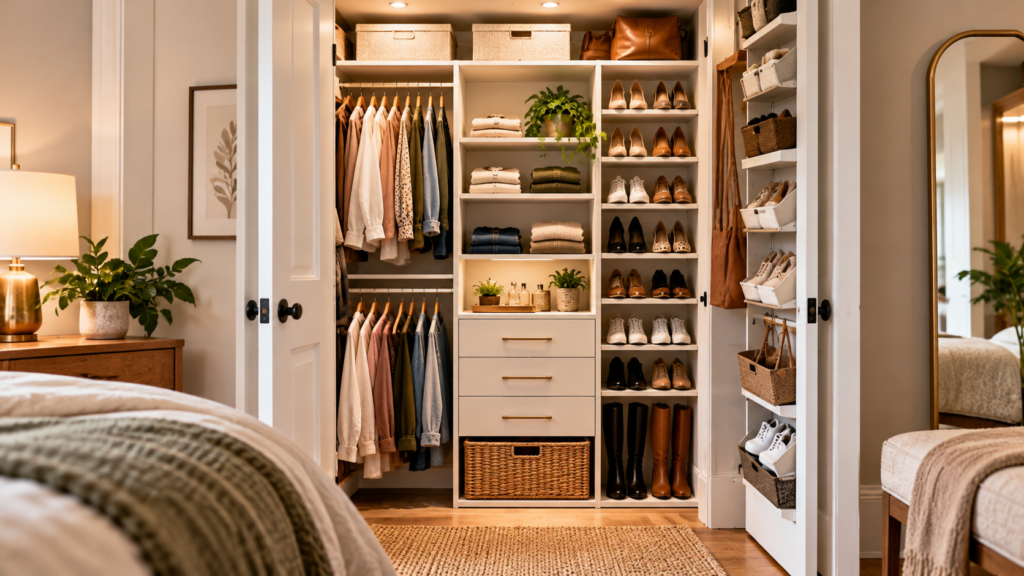
- Put a drawer tower in the middle. Drawers replace a dresser and free up bedroom floor. Place the tower inside the door opening so every drawer can open fully past the door frame.
- Use the returns for things you reach for less. Fill the hidden ends with shelves for bags and seasonal items, or a short rod for off-season coats. A corner shelf unit makes the back corner visible.
- Build to the ceiling. Add a second shelf at about 84 inches for luggage, spare bedding and out-of-season clothes. A small step stool lives in the closet.
- Mix depths. Shelves at 12 to 14 inches deep in a 24-inch closet leave room to stand closer and see what is at the back. Hanging stays at full depth.
- Give shoes their own spacing. Shoe shelves at 7 to 8 inches hold two rows of flats in the height one boot shelf uses. Keep one taller section for boots. Our guide to organizing shoes and bags has more on this.
- Switch to slim hangers. Matching slim hangers fit about 12 garments per linear foot, compared with about 9 on wooden ones. That is a third more capacity for the price of hangers.
- Add pull-outs where depth is short. In a 22-inch closet, a pull-out valet rod or a pull-out pants rack lets you hang facing forward without crushing garments against the back wall.
- Rethink the door. Bifold and sliding doors only show part of the closet at once, and a slider always hides half. Hinged doors that open fully, or removing the doors in favor of a cased opening, make the returns usable. The back of a hinged door can carry a slim mirror or hooks.
- Light the inside. A single bedroom ceiling light leaves the closet in shadow. Battery or hardwired LED strips under the shelf put light on the clothes. See our closet lighting ideas.
- Make it adjustable. Rods and shelves on adjustable systems move as a wardrobe changes. This matters most in kids’ closets, where a low rod at 30 to 36 inches can be raised as they grow.
A Worked Example: One 6-Foot Builder Closet, Redesigned
Take a common bedroom reach-in: 72 inches wide inside, 24 inches deep, an 8-foot ceiling and a 48-inch door opening. That leaves a 12-inch return on each side.
Before: one rod at 66 inches across the full width, one shelf above it. That is 6 linear feet of single hanging, or about 72 garments on slim hangers. There are no drawers, so a dresser takes up bedroom floor.
After: the same wall, divided into three sections.
| Section | Width | What it holds |
|---|---|---|
| Left: double hang at 40 and 80 in | 30 in | 5 linear ft of shirts, blouses and jackets |
| Center: drawer tower with shelves above | 18 in | 5 drawers, plus folded shelves to 84 in |
| Right: long hang at 66 in | 24 in | 2 linear ft of dresses and coats, two shelves above |
The hanging space rises from 6 to 7 linear feet, which is about 84 garments on slim hangers. On top of that, the closet now holds five drawers and a second shelf level across the full width. For many people that is enough to remove a dresser from the bedroom entirely. The drawer tower sits inside the door opening, so every drawer opens fully. The left return carries hanging you reach for daily from the front, and the right return holds long garments you reach for less.
Nothing about the room changed. Only the allocation did.
Small Closet Mistakes to Avoid
- Buying organizers before measuring. Hanging shelves and over-rod baskets often fit the catalog, not the closet. They also block the rod you were trying to use.
- Placing drawers behind the door frame. A drawer in the return cannot open past the jamb. Drawers belong inside the opening.
- Double-hanging everything. Long garments folded over a lower rod crease and drag. Keep a long-hang section sized to what you actually own.
- Deep shelves. A 24-inch-deep shelf in a reach-in becomes a stack you dig through. 12 to 14 inches keeps everything visible.
- Ignoring the ceiling. The space above the shelf is the cheapest storage in the house. Leaving it empty is the most common waste we see.
- Fixed components in a kids’ closet. A layout set for a six-year-old is wrong by ten.
How Much Does a Custom Reach-In Closet Cost?
A reach-in is usually the least expensive custom closet project, because the wall is short and the layout is simple. What moves the price is the same as in larger closets: the number of drawers, whether the system runs to the ceiling, the finish, and accessories like pull-outs and lighting. A design with a few well-placed drawers often costs less than one with many accessories nobody uses.
For how projects are priced in this region, see our guide to custom closet costs in the DMV. For an exact number, a free in-home consultation with a 3D design is the fastest route.
Get More From the Closet You Already Have
A small closet is a fixed amount of wall. The right layout decides whether it holds a season of clothes or a whole wardrobe. St. James Closets designs, builds and installs custom closets across Northern Virginia, Washington, DC and Maryland from our Fairfax location at 9560 Blenheim Blvd. Every project starts with a free in-home measurement and a 3D design, so you see the layout before anything is built.
Call 703-547-7770 or book a free consultation, and we will measure your reach-in and show you exactly what it can hold.
Small Closet Ideas FAQ
How do I maximize space in a small reach-in closet?
Double-hang most of the rod, keep a short long-hang section, add a drawer tower inside the door opening and build shelves to the ceiling. Those four changes usually add more than any organizer product.
What is the standard depth of a reach-in closet?
24 inches is standard and fits a garment on a hanger. Many older homes have 22 to 23 inches, which still works with care. Below 22 inches, use pull-out rods so clothes hang facing forward.
Can you put drawers in a reach-in closet?
Yes, as long as they sit within the door opening. Drawers in the returns cannot clear the door frame. An 18- to 24-inch drawer tower is the usual choice.
Are bifold or sliding doors better for a small closet?
Neither is ideal. Both hide part of the closet. Hinged doors or an open cased opening give full access, which matters most when the closet has returns.
Is a reach-in better than a small walk-in?
Often, yes. Below roughly 5 by 5 feet, a walk-in gives up much of its floor to the aisle. A well-fitted reach-in on the same wall can hold more.